Voyager: AI Swift Browser
- 4.4
- Rating
- 1.00M
- Installs
- Free
- Price

 Analysis by App-foxy
I approached Voyager: AI Swift Browser as a practical tool rather than another app to open once and forget. Its simple promise is to make everyday internet use more enjoyable, but the useful question is what that means when I begin with a real task: finding something, checking several pages, deciding what matters, and then passing the result into the next part of my day. As a free tools app from James c. Ross, it is aimed at people who want a straightforward way to browse on an Android device without treating the browser as a complicated project.
My first impression is that Voyager is easiest to understand when I use it as the starting point for a small workflow. I open it with a question, search or visit the relevant page, read enough to form an answer, and then move that information into an email, message, note, purchase decision, or conversation. That sounds ordinary, but it is exactly where a browser earns its place. The app has reached more than a million installs and holds an average rating of 4.1 from roughly five thousand ratings, so it has clearly found an audience beyond a handful of curious testers.
From an unfinished question to a usable answer
I find that an unfinished question is often the most realistic place to begin: I may know what I need to decide but not the exact words to search. This section looks at how Voyager can fit into that early exploration, while keeping the distinction clear between discovering an answer and confirming one. From there, the next section considers what changes when several people share a device.
You May Also Like

 Blood Strike: 2.5 Anniversary
Blood Strike’s Loadouts Turn Every Drop Into a Tactical Gamble
A close look at Blood Strike’s custom loadouts: how fast access to signature weapons reshapes its battle royale rhythm, rewards preparation, and narrows the gap between fights.

 Pandora - Music & Podcasts
Pandora’s Music Is Easy to Start, but Harder to Recover
Pandora’s strength is its low-effort path from a seed to a station. Its weak spot is how much confidence it asks you to place in connection, setup, and quiet recovery.

 8 Ball Pool
 Is Built on Rivalries, Rematches, and Routine
A close look at the rivalries, rematches, shared routines, and unanswered safety questions that turn a quick pool match into a persistent mobile community.

 Samsung Music
’s Quiet Strength Is Playing What You Already Own
Its reach comes less from spectacle than from dependable access to a personal library. That simplicity is both the app’s strongest retention engine and its ceiling.

 AccuWeather: Weather Radar
AccuWeather Review: A Quick, Clear Forecast for Everyday Decisions
For everyday plans, the best forecast is the one you can understand quickly. AccuWeather makes rain timing, radar, and local conditions easy to act on, with a few trade-offs.

 Hill Climb Racing
Why Hill Climb Racing Still Turns Crashes Into One More Run
A tiny car, a bumpy hill and one more upgrade: Hill Climb Racing keeps resurfacing because its simple chaos makes every near-miss feel personal.
More From Our News Desk



Beginning with the situation that sends me online
A realistic example is planning a short trip. I may begin with a vague thought such as “What should I take?” rather than a neatly formed search query. Voyager works best when I turn that thought into a sequence of small checks: weather, opening times, transport information, and a page with practical advice. The browser is not the decision itself; it is the place where I collect enough context to make one.
That distinction matters because a browser can feel fast while still leaving the user with a messy pile of tabs and half-read pages. I try to give each visit a purpose. One page answers a factual question, another supplies a detail to compare, and a third confirms whether the plan is realistic. This approach makes the app feel more useful than simply typing a term and scrolling without direction.
The short store description calls Voyager an “AI Swift Browser,” while its store summary focuses on enjoying the internet. In practice, I would not choose it solely because of those words. I would choose it when I want a light, accessible browsing tool and am willing to judge its value by how smoothly it supports my own routine. The AI emphasis may attract people who want assistance around browsing, but it should not replace careful reading or source checking.
Turning browsing into a repeatable sequence
My preferred flow starts with one clear search, followed by a quick scan of the results. I avoid opening every promising result at once. Instead, I open the page most likely to answer the immediate question, identify the useful detail, and then return to the search when I need a second source. This reduces the common browser problem of losing the original purpose inside a growing collection of pages.
A useful habit is to separate discovery from confirmation. During discovery, I am looking for vocabulary, possible options, and the names of relevant services. During confirmation, I check the exact detail that will affect my decision. Voyager fits this pattern because it lets me treat browsing as a chain of handoffs rather than one endless session. I can move from a broad question to a specific page, then from that page to an action outside the browser.
For example, if I am comparing two products, I first look for the specifications that actually matter to me. I then check the manufacturer or retailer page instead of relying only on a short search preview. Finally, I copy the important distinction into a note or message. The non-obvious advantage here is not a special button; it is the discipline of using the browser as a filter. I spend less time collecting pages that I will never revisit.
Where the handoffs become important
Most browsing tasks do not end inside the browser. I may need to send an address to a friend, save a reference for later, copy a booking detail, or explain a choice to someone else. Voyager is therefore only one link in the chain. Its success depends on whether the transition from reading to acting feels natural on my device.
I find it helpful to pause before leaving a page and identify exactly what I am handing off. Is it a link, a name, a time, a short quotation, or my own conclusion? Copying only the relevant detail is often better than forwarding a page with no explanation. This is especially useful when a recipient is using a different browser or does not want to repeat the research.
Another practical tip is to keep a compact note beside the browsing task. I write the question at the top, then add the answer and the page that supports it. This prevents a later handoff from becoming a second research session. It also exposes weak results quickly: if I cannot summarize why a page matters, it probably has not helped me enough yet.
For a family errand, the flow might begin with checking a store’s information, continue with comparing travel options, and end with sending one clear recommendation. For work, it might begin with a technical term and end with a short explanation for a colleague. In both cases, the app is most valuable when it shortens the path between curiosity and a concrete next step.
What the app’s positioning means in daily use
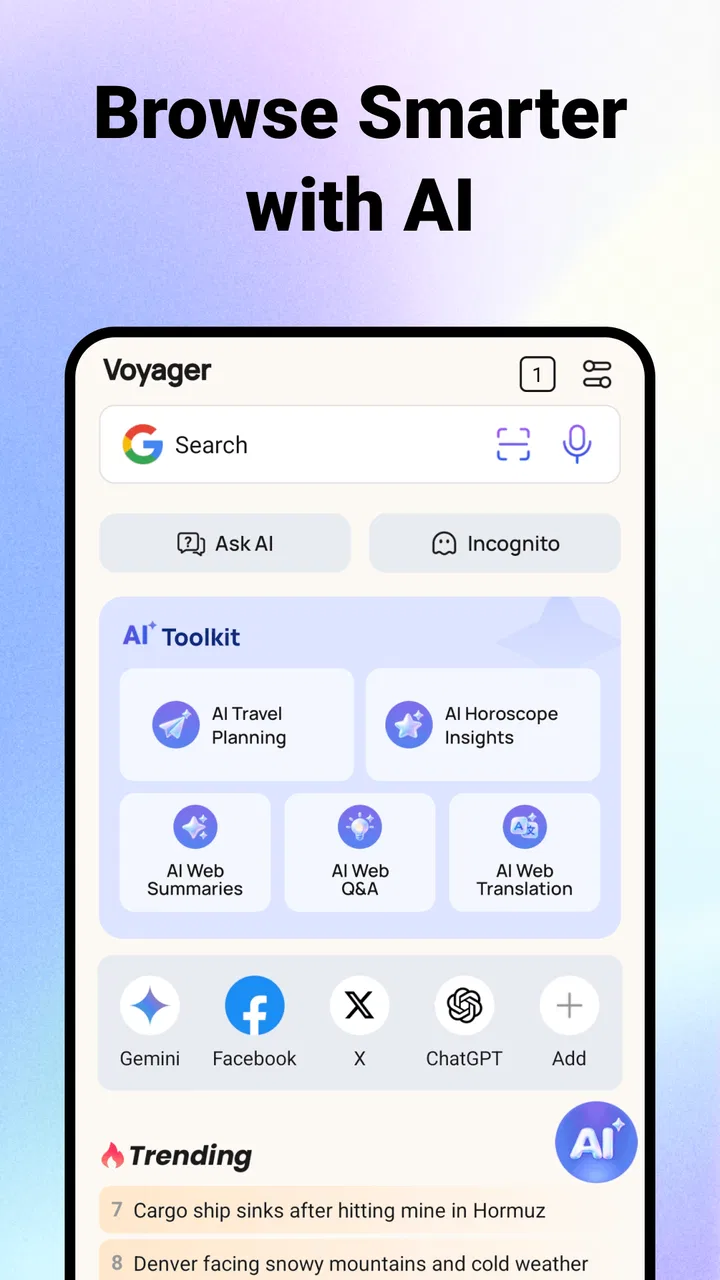
Calling Voyager an AI browser creates an expectation of help beyond ordinary page loading. I would approach that promise carefully. AI-oriented assistance can be useful for organizing a question or helping me think about what to look for, but it does not remove the need to inspect the original page. If an answer affects money, travel, health, or work, I still verify the wording and context myself.
This is one of the important trade-offs. A conventional browser may feel more predictable because I know exactly where the search box, tabs, history, and sharing controls are. Voyager’s appeal is that it presents browsing as something more guided and conversational, but any extra layer can also become friction if I only want to reach a familiar website quickly. People who prefer complete control and minimal interpretation may feel more comfortable with a traditional browser.
On the other hand, someone who often starts with an imprecise question may appreciate the app’s focus. It gives that person a reason to slow down, clarify the goal, and use the web as a source of connected answers rather than isolated results. I see the strongest fit among casual researchers, students checking everyday topics, and users who want a dedicated browsing option without paying for it.
The outcome: less searching, better decisions
The result I want from Voyager is not a dramatic feature demonstration. It is a completed task. I want to finish with a reliable answer, a useful link, or enough information to take the next step. When I keep the workflow narrow, the app supports that outcome well: question, search, inspect, compare, and hand off.
The biggest improvement comes from deciding in advance what “done” means. If I am looking for a service, done may mean finding its contact route and hours. If I am researching a purchase, done may mean identifying the one specification that separates two choices. If I am preparing a message, done may mean having one source and a concise explanation. Without that boundary, even a fast browser can encourage unnecessary scrolling.
Voyager is also a reasonable choice for people who want a free app with an Everyone content rating and broad device accessibility. It supports Android devices running version 7.0 or later, which makes it relevant to users who are not using the newest hardware. The current version is 1.0.17, so I would still keep the app updated through the normal store process when updates are available.
The developer is listed as James c. Ross, and the app’s free price removes one obvious barrier to trying it. That makes experimentation easy: I can use it for a few real tasks, compare the experience with my usual browser, and decide whether its style suits me. I do not need to reorganize my entire digital life before learning whether it saves me time.
Where the workflow breaks down
The first weak point is expectation management. If I expect the AI label to produce perfect research, I will be disappointed. Browsing assistance can help me frame a task, but it cannot guarantee that every page is accurate, current, or relevant. The more consequential the decision, the more important it becomes to read the source rather than accept a convenient summary.
The second weak point is the handoff between the app and everything around it. A browser may locate the right information, yet the final action can still be awkward if I have to reformat text, explain the context, or move details into another app. This is not unique to Voyager, but it matters because the real value of a browsing session is measured after the page is closed.
The third issue is fit. I would skip Voyager if I need a highly established browser ecosystem with deep synchronization across many devices, a large collection of extensions, or a familiar interface shared by a whole team. In those situations, a mainstream alternative may be better because consistency and compatibility matter more than trying a different browsing approach.
I would also skip it for sensitive research unless I have first reviewed the app’s behavior and feel comfortable with the way I use it. The safest habit is to avoid entering private information into any unfamiliar online tool, keep important accounts in the browser I already trust, and treat AI-assisted output as a starting point rather than a final authority. That advice is especially relevant when the task involves personal records or financial decisions.
Who will get the most from it
Voyager makes the most sense for an Android user who wants a free tools app for everyday web exploration, especially when the starting point is a question rather than a known URL. It is a good candidate for quick research, casual comparisons, planning, and collecting information that will soon be shared with another person. The app’s broad age rating also makes it approachable for general household use, provided each person follows sensible online safety habits.
It is less convincing for someone who already has a carefully tuned browser workflow and values established synchronization, extensive customization, or a large extension library. That user may gain little from changing browsers unless Voyager’s AI-centered approach solves a specific problem. Switching only for novelty is unlikely to justify the adjustment period.
My advice is to test it with three different tasks rather than one. Use it for a simple lookup, a comparison that requires checking more than one page, and a task that ends with sharing information. Notice not only how quickly the first result appears, but also whether you can remember the useful detail, return to the right page, and pass the result to someone else without confusion. That test reveals more than a quick glance at the opening screen.
My recommendation after following the complete flow
After using Voyager as a beginning-to-end browsing tool, I see it as a practical experiment for people who want a different way to approach the internet. Its strengths appear when I start with an unfinished question and deliberately turn browsing into a short process with a clear outcome. The app is free, accessible on older Android versions, and already used by a substantial audience, which makes trying it a low-risk decision for many users.
I would recommend it to a friend who often searches for everyday information and wants help keeping the task focused. I would explain that the best results come from giving each session a purpose, checking important claims at their original source, and treating the final handoff as part of the job. The browser is useful when it helps you finish something, not merely when it helps you open more pages.
My final view is positive but measured. Voyager is not automatically a replacement for every familiar browser, and its AI positioning should not encourage careless trust. Still, for casual research and question-led browsing, it offers a worthwhile route from uncertainty to action. If that is the kind of workflow I need, I would keep it available and judge it by the quality of the outcomes it helps me reach.
FAQs for Voyager: AI Swift Browser
01What features does Voyager: AI Swift Browser offer?
Voyager: AI Swift Browser boasts a range of features designed to enhance your browsing experience. It includes a built-in AI assistant for quick searches, an ad-blocker for an uninterrupted experience, and customizable themes. Additionally, it offers secure browsing with privacy controls and a data-saving mode that optimizes content for faster loading.
02Is Voyager: AI Swift Browser secure for online transactions?
Yes, Voyager: AI Swift Browser prioritizes user security with robust encryption methods. It provides a private browsing mode that doesn't track your activity and includes built-in security features to protect against phishing and malware. This makes it a safe option for online transactions and accessing sensitive information.
03How does the AI assistant in Voyager: AI Swift Browser work?
The AI assistant in Voyager: AI Swift Browser is designed to streamline your browsing. It learns from your habits to offer personalized search results, suggests content based on your interests, and can perform tasks like setting reminders or checking the weather. Its intuitive interface makes it easy to access and use while browsing.
04Can Voyager: AI Swift Browser help save data usage?
Yes, Voyager: AI Swift Browser includes a data-saving feature that compresses web pages, reducing data consumption without compromising on quality. This is particularly useful for users on limited data plans, allowing for more browsing with less data usage, while still ensuring a smooth and fast browsing experience.
05Is Voyager: AI Swift Browser available for both Android and iOS?
Voyager: AI Swift Browser is available for both Android and iOS devices. It is optimized for each platform to ensure seamless performance, offering the same set of features and user-friendly interface across both operating systems. Users can download it from the Google Play Store or the Apple App Store.
Pros
- Fast and responsive browsing experience.
- Minimalistic and user-friendly interface.
- Built-in AI for smart search suggestions.
- Low data usage for efficient browsing.
- Secure with advanced privacy settings.
Cons
- Limited extensions compared to other browsers.
- Occasional glitches with media playback.
- AI suggestions can feel intrusive.
- Customization options are minimal.
- Requires constant updates for optimal use.

Voyager: AI Swift Browser
Gallery